

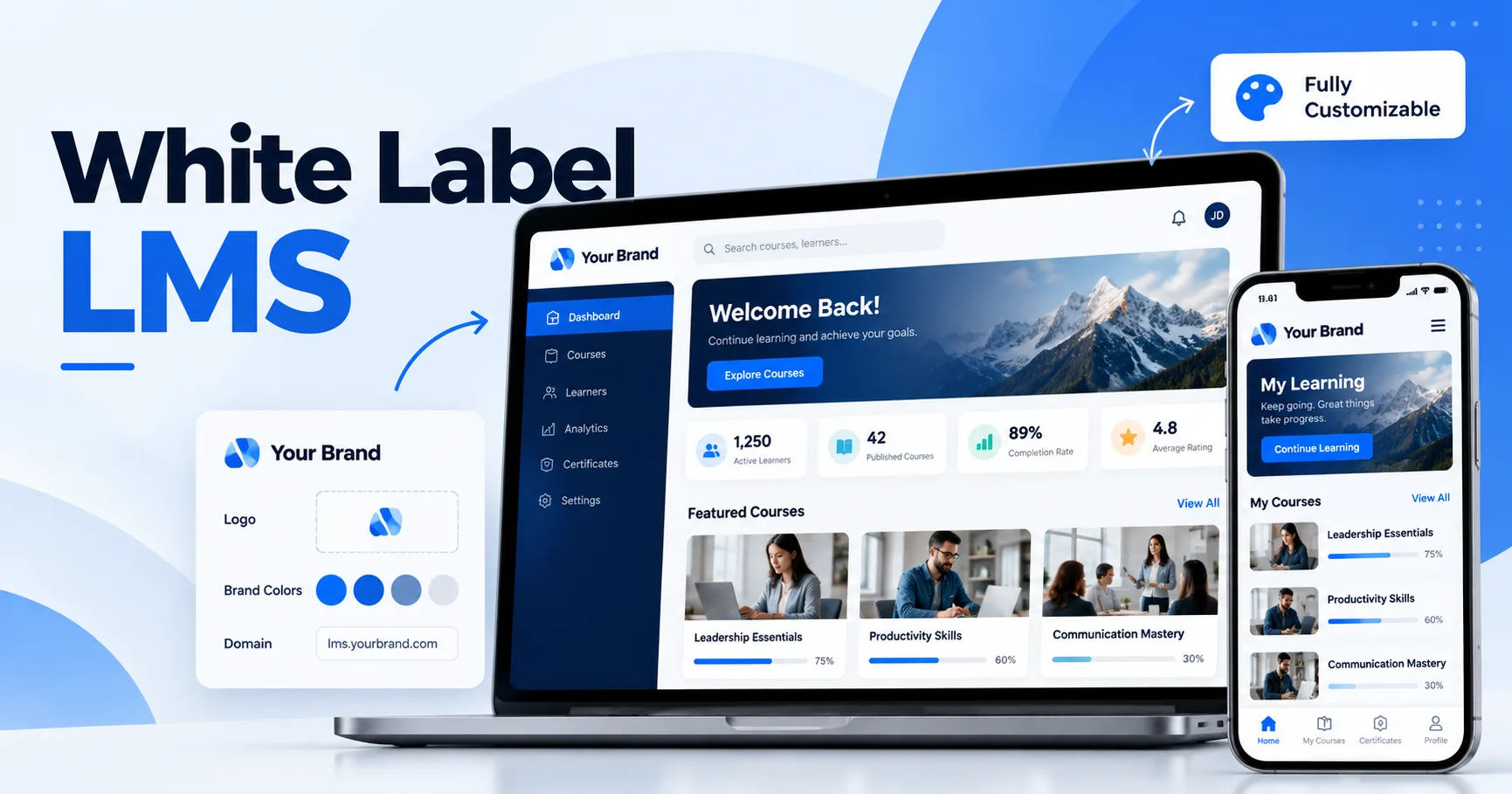
A white label LMS gives organizations the ability to deliver online education under their own brand, but branding alone is not enough to create a smooth learning experience. A modern learning management system should connect with the tools an organization already uses for communication, payments, marketing, reporting, customer management, and content delivery.
The right integrations can reduce manual work, improve the learner experience, and help administrators manage courses more efficiently. They can also make it easier for businesses, schools, training providers, and professional organizations to scale their online learning programs.
In this guide, we will explore the most important integrations a white label LMS should support and explain why each one matters.
Why Integrations Matter in an LMS
An LMS rarely works as an isolated system. Most organizations already depend on several digital tools. They may use a payment gateway to collect course fees, a customer relationship management platform to manage leads, an email service to communicate with learners, and video software to deliver lessons.
Without integrations, administrators may need to move information manually between these platforms. This can take time and increase the possibility of errors.
A well-connected LMS creates a more unified system. When a learner purchases a course, for example, the payment can be confirmed automatically, an account can be created, access can be granted, and a welcome email can be sent without requiring several manual steps.
Improving the Learner Experience
Integrations can make learning more convenient.
Students may be able to log in with an existing account, attend live classes through a familiar video platform, receive notifications through email, and access certificates automatically after completing a course.
A smoother experience can make the learning platform easier to use and manage.
Reducing Administrative Work
Automation is another major benefit.
Instead of manually checking payments, updating learner records, sending reminders, and generating reports, connected systems can handle many of these tasks automatically.
This allows administrators to spend more time improving courses and supporting learners.
Payment Gateway Integrations
Payment integration is especially important for organizations that sell courses, memberships, certifications, or training programs.
A white label LMS should support popular payment gateways and provide secure payment processing.
Supporting Multiple Payment Methods
Different learners may prefer different payment options. Depending on the target market, an LMS may need to support credit cards, debit cards, digital wallets, bank payments, or regional payment services.
Supporting several payment methods can make purchasing easier for customers.
Subscriptions and Recurring Payments
Some educational businesses use subscription models rather than one-time purchases.
For example, learners might pay monthly or annually for access to a course library. The LMS should be able to work with payment platforms that support recurring billing.
This can simplify subscription management and reduce administrative work.
Automatic Course Access
Payment and enrollment should ideally work together.
Once a transaction is successfully completed, the learner can automatically receive access to the purchased course. If a subscription expires, access can also be updated according to the organization's rules.
This creates a more reliable purchasing experience.
CRM Integrations
Customer relationship management systems help organizations manage leads, customers, and communication.
Connecting a CRM with an LMS can provide valuable information about learners and their activities.
Managing Leads and Learners
When someone registers for a webinar, downloads educational content, or purchases a course, the information can be transferred to the CRM.
Sales and support teams can then understand where that person is in the customer journey.
Personalizing Communication
CRM data can also support more relevant communication.
For example, an organization could send different messages to new learners, active students, inactive users, and people who have completed specific courses.
This can make marketing communication more useful and less repetitive.
Email Marketing Integrations
Email remains an important communication channel for online education.
A white label LMS should ideally connect with established email marketing platforms or provide reliable email automation capabilities.
Course Notifications
Email integrations can support important learner notifications such as enrollment confirmations, password information, course reminders, assignment updates, and completion messages.
Marketing Campaigns
Email marketing tools can also help organizations promote new courses and educational programs.
For example, learners who completed an introductory course could receive information about an advanced course that matches their previous activity.
Automated Reminders
Automation can help bring inactive learners back to their courses.
A learner who has not logged in for several weeks could receive a reminder encouraging them to continue their training.
Video Conferencing Integrations
Live instruction is still important for many educational programs.
An LMS should therefore support integration with video conferencing platforms used for virtual classrooms, workshops, coaching sessions, and meetings.
Live Classes
A video conferencing integration can allow instructors to schedule live sessions directly from the learning environment.
Learners can receive the meeting information without searching through separate communication channels.
Attendance Tracking
For professional training and formal education, attendance may be important.
An integration can help organizations record who attended a live session and connect that information with the learner's course record.
Recorded Sessions
Some organizations record live classes for students who cannot attend.
The LMS can provide a central location where recordings are made available after the session.
Single Sign-On Integrations
Single sign-on, commonly called SSO, allows users to access multiple services with one set of login credentials.
This can be particularly valuable for schools, universities, corporations, and large training organizations.
Easier Access
Learners do not need to remember another username and password.
They can use their existing organizational account to access the LMS.
Better Account Management
SSO can also make user administration easier.
When an employee leaves an organization, for example, access can be managed through the organization's identity system rather than requiring administrators to update multiple platforms manually.
Common identity standards and services can include SAML, OAuth, and OpenID Connect.
Cloud Storage Integrations
Online courses often contain large amounts of content, including videos, presentations, documents, images, and downloadable resources.
Cloud storage integrations can help organizations manage these materials efficiently.
Managing Course Files
Instructors can store learning resources in connected storage services while keeping the learner experience organized inside the LMS.
Scalability
Cloud-based storage can also help organizations handle growing amounts of educational content without relying entirely on local infrastructure.
Security settings and access permissions should still be carefully configured.
Analytics and Reporting Integrations
Data is essential for understanding how learners interact with courses.
A strong LMS should connect with analytics and reporting tools or provide flexible reporting through APIs and data exports.
Tracking Learner Progress
Administrators may want to know how many students started a course, how many completed it, and where learners commonly stop progressing.
This information can help identify areas where course content may need improvement.
Measuring Engagement
Organizations can examine metrics such as login frequency, lesson completion, assessment results, and time spent learning.
These measurements can help instructors understand how students interact with educational material.
Business Reporting
For commercial training providers, analytics can also help track enrollments, revenue, course performance, and customer activity.
Combining LMS data with business analytics can provide a broader view of the organization's operations.
Marketing Automation Integrations
Marketing automation platforms can help educational businesses manage campaigns based on learner activity.
For example, someone who visits a course page but does not enroll could receive a follow-up message.
Similarly, learners who finish one program could receive information about related courses.
Behavioral Segmentation
Integrations can allow organizations to divide audiences according to their actions.
Possible groups include new users, active learners, inactive learners, completed students, and customers interested in particular subjects.
This can make marketing campaigns more targeted.
Webinar Platform Integrations
Webinars are frequently used to educate audiences and generate interest in paid courses.
An LMS that integrates with webinar platforms can connect marketing events with learning programs.
For example, an organization could host a free webinar and then direct attendees toward a related paid course.
Registration information can also be synchronized with other systems, reducing the need for manual data entry.
E-Commerce Integrations
Some organizations operate large online stores alongside their educational platforms.
E-commerce integrations can connect product catalogs, customer information, orders, and course access.
This can be useful when an organization sells physical products as well as digital education.
For example, a company selling professional equipment might also sell training courses explaining how to use those products.
HR and Workforce Management Integrations
Corporate training often needs to work alongside human resources systems.
HR integrations can synchronize employee information with the LMS.
Employee Onboarding
When a new employee joins an organization, required training can be assigned automatically.
This can make onboarding more consistent.
Compliance Training
Organizations may also need employees to complete mandatory training.
Integration with HR systems can help administrators identify who has completed required courses and who still needs to participate.
Employee Records
Training results can potentially be associated with employee profiles, depending on the organization's privacy and data-management policies.
Certification Integrations
Many training programs provide certificates after learners complete specific requirements.
A white label LMS should support certificate generation or integration with certification systems.
Certificates may include the learner's name, course title, completion date, certificate number, and issuing organization.
Automated certificates can save administrators considerable time.
For professional education, organizations may also need integrations that support continuing education credits or other forms of professional recognition.
API Integrations
An API is one of the most important capabilities for organizations that need custom integrations.
Instead of depending only on built-in connections, an API allows developers to connect the LMS with other applications.
Custom Workflows
Every organization has different requirements.
A company might want its LMS to communicate with a proprietary employee portal, custom mobile application, internal database, or specialized business software.
An API can make these connections possible.
Data Synchronization
APIs can also synchronize information such as users, courses, enrollments, progress, and completion records.
When evaluating an LMS, organizations should examine API documentation, authentication methods, available endpoints, rate limits, and security controls.
Webhook Support
Webhooks are another useful integration feature.
While an API generally allows one system to request information from another, webhooks can notify another system when a specific event occurs.
For example, an LMS could send an event when a learner completes a course.
The connected application could then automatically update a CRM record, issue a certificate, or trigger an email workflow.
Mobile and App Integrations
Many learners access courses through smartphones and tablets.
A modern LMS should support mobile experiences and, where appropriate, integrations with mobile applications.
Push notification services can also help learners receive reminders about upcoming classes, new lessons, assignments, or important announcements.
A consistent experience across desktop and mobile devices can make learning more accessible.
Security and Privacy Integrations
Integrations should not only be convenient. They must also be secure.
An LMS may process names, email addresses, payment information, educational records, and other sensitive data.
Organizations should examine how integrations authenticate users and transfer information.
Authentication
Secure authentication methods help prevent unauthorized access.
SSO, OAuth, SAML, and other established technologies can support safer account management.
Data Protection
Organizations should also understand what information is shared with each connected service.
Only necessary information should be transferred, and access permissions should be appropriately limited.
How to Choose the Right Integrations
Not every organization needs every integration.
The right combination depends on the organization's business model, audience, existing software, and technical requirements.
Start by identifying the systems already used by the organization.
Then consider which processes are currently manual or difficult to manage.
For example, if administrators spend hours manually confirming payments and enrolling students, payment integration should be a priority.
If corporate customers require employee training records, HR and reporting integrations may be more important.
Look for Open Integration Standards
An LMS should not force an organization into a closed technology ecosystem.
Support for APIs, webhooks, SSO standards, and common data formats can make future expansion easier.
Consider Scalability
An integration that works for 100 learners may not be sufficient for 100,000 learners.
Organizations should consider performance, API limits, synchronization speed, and reliability before selecting a platform.
Evaluate Security
Every integration creates another connection between systems.
Organizations should examine authentication, encryption, permissions, audit logs, and data-handling practices before connecting external services.
The Role of Integrations in a White Label LMS
The value of a white label LMS extends beyond changing logos, colors, and domain names.
A truly useful platform should fit naturally into an organization's broader technology environment.
Payment systems can support transactions. CRM integrations can organize customer information. Email platforms can manage communication. Video tools can support live teaching. Analytics systems can provide insight into learner behavior.
Together, these integrations can create a connected learning ecosystem.
Conclusion
A modern white label LMS should be able to connect with the tools an organization needs to operate, teach, communicate, and grow. Payment gateways, CRM platforms, email marketing services, video conferencing tools, SSO providers, cloud storage, analytics platforms, HR systems, certification services, APIs, and webhooks are among the most valuable integration options to consider.
The most important point is that organizations should choose integrations based on their actual workflows rather than simply selecting a platform with the longest integration list.
A small training provider may primarily need payments, email, video conferencing, and analytics. A large corporation may require SSO, HR synchronization, compliance reporting, APIs, and advanced security controls. An education business may place greater emphasis on e-commerce, marketing automation, webinars, and subscription payments.
Before choosing an LMS, it is useful to map the entire learner journey, from registration and payment through learning, assessment, communication, and certification. Then identify which systems need to exchange information at each stage.
When integrations are reliable, secure, and scalable, the LMS becomes more than a place to host courses. It becomes part of a connected digital learning environment that can reduce administrative work, improve the learner experience, and support long-term growth.