
Caps are one of the most popular items for embroidered logos, names, sports designs, business branding, and promotional artwork. However, creating embroidery for a cap is different from preparing a design for a flat garment such as a shirt or jacket. The curved surface, limited embroidery area, fabric structure, and stitching direction all affect the final result.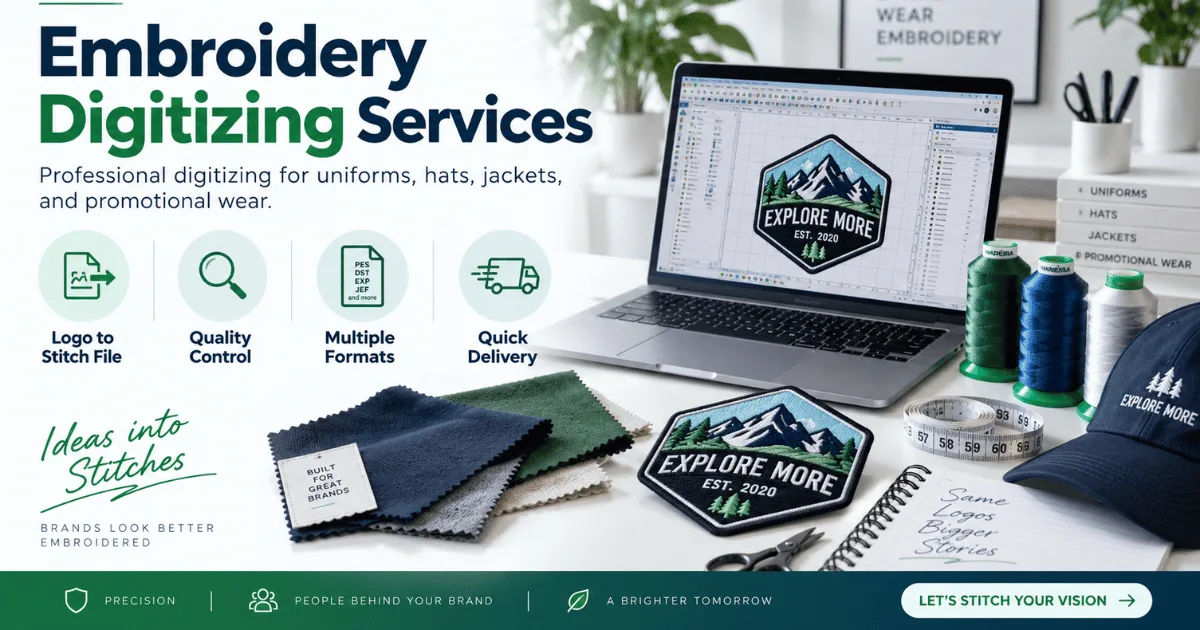
This is why many businesses and individuals wonder whether professional embroidery digitizing services can create designs specifically for caps. The answer is yes. Experienced digitizers can prepare embroidery files that are designed around the unique shape and construction of caps.
Cap embroidery requires more than simply converting an image into a machine-readable file. A skilled digitizer must consider the cap's front panel, center seam, fabric type, design size, stitch density, underlay, thread direction, and machine behavior. Proper preparation helps the design sew smoothly and look clean after stitching.
Why Cap Embroidery Requires Special Digitizing
The Curved Surface
A cap is not a flat piece of fabric. Its front panel usually has a noticeable curve, especially when the cap is structured. This curve can affect how stitches settle on the material.
If a design is digitized without considering the curve, certain areas may become distorted. Circles can appear uneven, text may lose its shape, and small details may not line up correctly.
Professional digitizers adjust the design so that it works with the natural shape of the cap.
The Center Seam
Many caps have a seam running vertically through the center of the front panel. This seam creates an important challenge for embroidery.
A design placed directly over the seam can experience resistance as the needle passes through different layers of material. Poor planning can lead to uneven stitching, thread breaks, or an inconsistent appearance.
An experienced digitizer can adjust stitch placement and sequencing to reduce problems around the seam.
Limited Embroidery Space
Caps generally provide less embroidery space than jackets, bags, or large shirt panels. A design that looks excellent when enlarged may become difficult to stitch when reduced to cap size.
Professional digitizers understand these limitations and simplify artwork when necessary. They can remove unnecessary details while keeping the main appearance and identity of the design.
What Types of Cap Designs Can Be Digitized?
Business Logos
Business logos are commonly embroidered on caps for employees, promotional campaigns, uniforms, and customer merchandise.
A digitizer can convert a company logo into an embroidery file while adjusting its details for the available cap area.
Small text may need to be enlarged slightly or redesigned so that it remains readable after stitching.
Sports Team Designs
Caps are widely used for baseball, softball, basketball, football, and other sports. Team names, numbers, mascots, and symbols can all be prepared for embroidery.
Sports designs often benefit from strong outlines and carefully planned stitch directions. These features can make the finished embroidery easier to recognize from a distance.
Names and Initials
Simple names and initials are often suitable for cap embroidery. They can be used for personal gifts, clubs, schools, businesses, and uniforms.
The main consideration is choosing lettering that remains clear at a small size. Extremely thin fonts may not translate well into thread.
Decorative Artwork
Decorative symbols, animals, icons, and other artwork can also be digitized for caps.
However, complicated artwork may need to be simplified. Too many tiny stitches can create unnecessary density and may make the finished design look crowded.
How Professional Cap Digitizing Works
Artwork Evaluation
The process usually begins with an examination of the original artwork.
The digitizer considers the design's dimensions, colors, outlines, lettering, shapes, and level of detail. They also consider where the design will be embroidered and what type of cap will be used.
This evaluation helps determine how the artwork should be converted into stitches.
Design Scaling
Size is extremely important in cap embroidery.
A design must be large enough for important elements to remain visible but small enough to fit comfortably within the cap's embroidery area.
Simply shrinking a large embroidery file can produce poor results because stitch lengths, densities, and small details do not automatically become suitable for the new size.
Professional digitizers can rebuild or adjust the design instead of relying on basic automatic resizing.
Stitch Direction Planning
Stitch direction affects the appearance and stability of embroidery.
Different parts of a logo may require different stitch directions. For example, lettering, borders, leaves, geometric shapes, and curved elements may all need carefully selected angles.
Good stitch direction can improve the texture of the design and help it follow the shape of the cap.
Underlay Selection
Underlay stitches are placed beneath the visible embroidery. They provide support and help stabilize the fabric.
Caps can require careful underlay planning because the material and curved surface can influence how the top stitches behave.
Too little support may result in weak or uneven embroidery. Too much support can create unnecessary bulk.
The goal is to use enough underlay to stabilize the design without making the embroidery excessively heavy.
What Cap Materials Can Be Digitized?
Caps are produced from many different materials, and each one can behave differently under a needle.
Cotton Caps
Cotton caps are common and can generally support a wide range of embroidery designs. However, the fabric weight and construction still need to be considered.
A lightweight cotton cap may require different settings from a thick, structured cotton cap.
Polyester Caps
Polyester caps are popular for sportswear and outdoor applications. They can offer a smooth embroidery surface, but the specific fabric construction matters.
The digitized design should be matched to the material to achieve consistent coverage and clean edges.
Twill Caps
Twill provides a durable surface and is frequently used for embroidered caps. Bold logos, lettering, and simple graphics can work particularly well on twill.
Nevertheless, the thickness and stiffness of the material should still be considered when preparing the embroidery file.
Foam Caps
Foam is commonly associated with three-dimensional puff embroidery. These designs require special digitizing techniques because the embroidery needs to interact with the foam layer.
A design intended for 3D puff should not simply be converted from a standard flat embroidery file. Stitch order, density, outlines, and spacing all need careful attention.
Can 3D Puff Designs Be Made for Caps?
Yes, caps are one of the most common applications for 3D puff embroidery.
The technique uses foam beneath the thread to create raised lettering or shapes. It is particularly popular for bold logos, sports designs, and short words.
However, not every design is suitable for puff embroidery.
Choosing Suitable Artwork
Large, bold shapes tend to work better than highly detailed artwork. Thin lines and tiny lettering can be difficult to reproduce effectively with foam.
A digitizer may recommend simplifying the design or changing certain elements to improve the finished appearance.
Planning the Stitch Order
Stitch sequencing becomes especially important with puff embroidery.
The digitizer must plan how the machine will cover the foam and where the stitches will stop and start. The objective is to create a clean raised effect while allowing excess foam to be removed afterward.
Why Use Professional Digitizing for Caps?
Better Stitch Quality
One of the biggest advantages of using professional digitizing is improved stitch quality.
Experienced digitizers understand how different stitch types behave on curved surfaces. They can make adjustments that help prevent gaps, excessive overlaps, and unnecessary thread buildup.
Improved Design Clarity
A logo may contain small details that look perfect on a computer screen but become unclear when embroidered.
Professional digitizing focuses on what the design will actually look like in thread. Details can be simplified or strengthened when necessary.
Fewer Production Problems
Poorly prepared embroidery files can cause thread breaks, needle problems, puckering, uneven coverage, and other production issues.
Although no digitizing process can guarantee that every machine will behave perfectly, a properly prepared file can reduce many common problems.
Better Use of Thread
Stitch count and density affect both appearance and production cost.
An inefficient file may use unnecessary stitches. A skilled digitizer can often create an efficient design while maintaining sufficient coverage.
This can help reduce production time and thread consumption.
How to Prepare Artwork for Cap Digitizing
Use High-Quality Artwork
A clear source image makes the digitizing process easier.
Vector artwork is particularly useful because it allows shapes and lines to be examined without the limitations of a low-resolution image. However, raster images can also be used when they are clear enough.
Explain the Intended Cap Size
Tell the digitizer the approximate size you want for the finished embroidery.
A design intended for a small front panel may require different treatment from one intended for a larger decoration.
Mention the Cap Type
If possible, provide information about the cap material and construction.
A structured baseball cap, unstructured cap, foam trucker cap, and lightweight promotional cap may all require different approaches.
Identify Important Details
If certain parts of the logo are especially important, communicate that clearly.
For example, a company may consider its lettering more important than a small decorative element. Knowing this helps the digitizer decide which details should receive priority.
How File Formats Affect Cap Embroidery
Embroidery machines use specialized file formats. The correct format depends on the machine being used.
Common formats include DST, PES, JEF, EXP, and other machine-specific formats.
A digitizing company may provide multiple formats when requested. However, it is important to know which format your embroidery machine requires before ordering.
The file format itself does not determine whether the design is good. The underlying digitizing quality is much more important. A technically correct file can still produce poor embroidery if its stitch structure has not been properly planned.
Should Cap Designs Be Tested?
Why Testing Matters
Testing is an important part of professional embroidery production.
A design that looks correct in digitizing software may behave differently when sewn onto an actual cap. The test stitch-out can reveal problems that are difficult to predict on a computer screen.
Testing can help identify issues with density, registration, stitch direction, lettering, outlines, and placement.
Testing on Similar Material
Ideally, the design should be tested on material similar to the final cap.
This provides a more realistic indication of how the embroidery will look in production. Testing on a completely different material may not reveal the same problems.
Common Cap Digitizing Mistakes
Using Excessive Stitch Density
Too many stitches can make an embroidered cap unnecessarily heavy and stiff.
Excessive density may also increase production time and create thread-related problems.
Making Small Text Too Small
Tiny lettering is one of the most common problems with cap embroidery.
Thread has physical limitations. Letters that are readable on a screen may become difficult to recognize when converted into very small stitches.
Ignoring the Cap Seam
The center seam should not be treated as an insignificant detail.
Design placement and stitch sequencing should take the seam into consideration, particularly when the design crosses the center area.
Treating Caps Like Flat Garments
A file created for a flat shirt front may not perform equally well on a curved cap.
Cap embroidery requires adjustments based on the shape and construction of the item.
How to Choose the Right Digitizing Service
When selecting professional embroidery digitizing services, look beyond the advertised price.
Look for experience with cap embroidery specifically. A company that mainly handles flat garments may not have the same level of experience with curved cap panels.
You should also consider whether the service provides revisions, multiple machine formats, test stitch-outs, and clear communication.
Examples of previous cap embroidery work can be useful when evaluating quality. Pay attention to lettering, curves, borders, small details, and the overall cleanliness of the stitching.
Customer reviews can also provide insight into reliability, turnaround time, communication, and consistency.
What Should You Expect From a Quality Cap File?
A good cap embroidery file should be designed around the actual application.
The stitches should provide appropriate coverage without creating excessive bulk. Lettering should remain readable, shapes should hold their form, and colors should be separated correctly.
The design should also have an efficient stitch sequence.
Quality is not simply about having a high stitch count. In many cases, thoughtful digitizing can produce a better result with fewer unnecessary stitches.
Can Existing Embroidery Designs Be Converted for Caps?
Sometimes an existing embroidery design can be adapted for a cap.
However, conversion is not always as simple as changing the dimensions. A design originally created for a shirt, jacket, or bag may need structural changes before it can work properly on a curved cap.
The digitizer may need to adjust stitch directions, density, underlay, lettering, and sequencing.
For this reason, it is often better to have the design specifically optimized for the cap rather than assuming an existing file will work without modification.
Benefits for Businesses
Cap embroidery can be an effective branding method for businesses.
Employees can wear branded caps as part of uniforms. Companies can also distribute embroidered caps at events, trade shows, sports activities, and promotional campaigns.
Because caps are highly visible, a well-designed embroidered logo can help reinforce brand recognition.
Using professional embroidery digitizing services can make the process easier because the artwork is prepared specifically for embroidery rather than simply converted without consideration for the cap.
Benefits for Personal Projects
Cap embroidery is not limited to businesses.
Individuals can create customized caps for birthdays, family events, clubs, hobbies, sports teams, school activities, and personal collections.
Names, initials, symbols, and custom artwork can all be prepared for embroidery.
A properly digitized design can make a simple cap look much more distinctive and professional.
Cost Considerations
The cost of digitizing depends on several factors.
Design complexity, stitch count, size, number of colors, turnaround time, and special techniques can all affect pricing.
3D puff designs may require additional preparation compared with simple flat embroidery.
It is also important to consider value rather than choosing a service based only on the lowest price. A cheap file that requires repeated corrections or produces poor embroidery may cost more in the long run.
Frequently Asked Questions
Can professional digitizers create files for baseball caps?
Yes. Experienced digitizers can prepare designs specifically for baseball caps, including structured and unstructured styles.
Can small logos be embroidered on caps?
Yes, but the logo may need to be simplified or adjusted. Very small details and thin lettering can be difficult to reproduce with thread.
Can 3D puff embroidery be digitized for caps?
Yes. Caps are one of the most common products for 3D puff embroidery. Bold artwork generally produces the best results.
Do caps require different digitizing from shirts?
Usually, yes. Caps have a curved surface, limited embroidery space, and often a center seam. These factors require special consideration.
Which embroidery format should I request?
The correct format depends on your embroidery machine. Ask the machine manufacturer or operator which format is required before ordering the file.
Is testing necessary?
Testing is strongly recommended, especially for detailed designs or large production runs. A test stitch-out can identify issues before many caps are embroidered.
When artwork needs to be prepared for embroidery, PSA Digitizing provides professional and convenient digitizing services. This embroidery digitizing company specializes in transforming logos and artwork into machine-compatible files, including DST, PES, JEF, and other popular formats. With its base in Clarkston, Georgia, USA, the team combines hands-on expertise with modern digitizing technology to create designs that are clean, precise, and ready to stitch.
PSA Digitizing has gained the trust of customers across the embroidery community and maintains a strong 4.5+ star rating on Trustpilot. From business logo digitizing to custom patches and embroidery machine files, the service is designed around quality, accuracy, dependable turnaround, and customer convenience. For professional digitizing assistance, visit psadigitizing.com.
Conclusion
Yes, professional embroidery digitizing services can absolutely create embroidery designs for caps. In fact, cap embroidery is a common and specialized application that requires careful planning.
The curved surface, center seam, limited design area, material type, stitch density, underlay, and stitch direction all influence the final result. A design that works perfectly on a flat garment may require significant adjustments before it can be used successfully on a cap.
Professional digitizing helps transform artwork into a practical embroidery file that is built around the characteristics of the cap. It can improve design clarity, reduce unnecessary stitches, support better registration, and make difficult details easier to reproduce.
Whether you need a company logo, sports emblem, name, initials, decorative artwork, or 3D puff design, the key is to prepare the embroidery specifically for the cap rather than treating it like a flat garment.
For the best outcome, provide clear artwork, specify the desired embroidery size, identify the cap material when possible, and tell the digitizer which embroidery machine format you need. Testing the design on a similar cap before large-scale production is also a smart step.
Ultimately, successful cap embroidery depends on matching the artwork, stitches, machine, and cap construction. With experienced professional embroidery digitizing services, even complex artwork can be carefully adapted to create clean, durable, and attractive embroidery on caps.